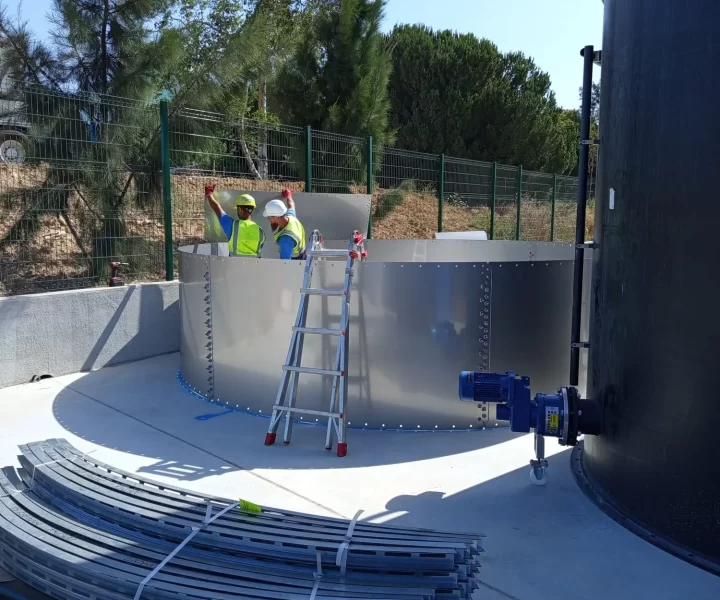
Stainless steel

Stainless steel

Stainless steel is used in metal tanks when corrosion must be minimized and the integrity of the stored fluid is paramount, especially in drinking water, the food and pharmaceutical industries, and critical facilities. Its resistance comes from the passive chromium oxide film that forms spontaneously on its surface and self-heals in case of micro-damage, thus preventing the progression of corrosion.

The most commonly used grades for tanks are AISI 304 and AISI 316. 304 steel offers excellent resistance in mildly aggressive environments, while 316 incorporates molybdenum, improving resistance to chlorides, salt spray, and industrial processes. For severe industrial applications or marine environments, 316L (low carbon) can be considered to improve weldability, or even duplex steels for combined loads and corrosion.

The lifespan of stainless steel tanks typically exceeds four decades with minimal maintenance, drastically reducing long-term operating costs. They require no internal coatings, eliminating risks such as delamination, porosity, chemical incompatibility, and degradation. This stability is particularly valued in data centers, agri-food plants, and municipal drinking water reservoirs.

In engineering terms, stainless steel maintains stable mechanical properties, allowing its use in conjunction with high hydrostatic loads or stresses from wind and seismic activity. Furthermore, its smooth surface reduces scaling, facilitates cleaning, and prevents chemical transfer.

Its main limitation lies in the initial cost, which is higher than that of other coatings. However, when analyzing the life cycle cost—considering virtually zero operating expenses—it becomes the most cost-effective option for projects with long time horizons or stringent sanitary requirements.
Recommended Applications


  • Data Centers
  • Municipal Warehouses
  • Food and Pharmaceutical
  • Marine and moderate chlorides

Advantages Applied to the Tank

Advantages applied to the tank:
  • Extreme resistance without additional coatings
  • Suitable for drinking water and hygienic environments
  • Minimal maintenance
  • Very high longevity
  • Stable structural behavior