Epoxy Coating
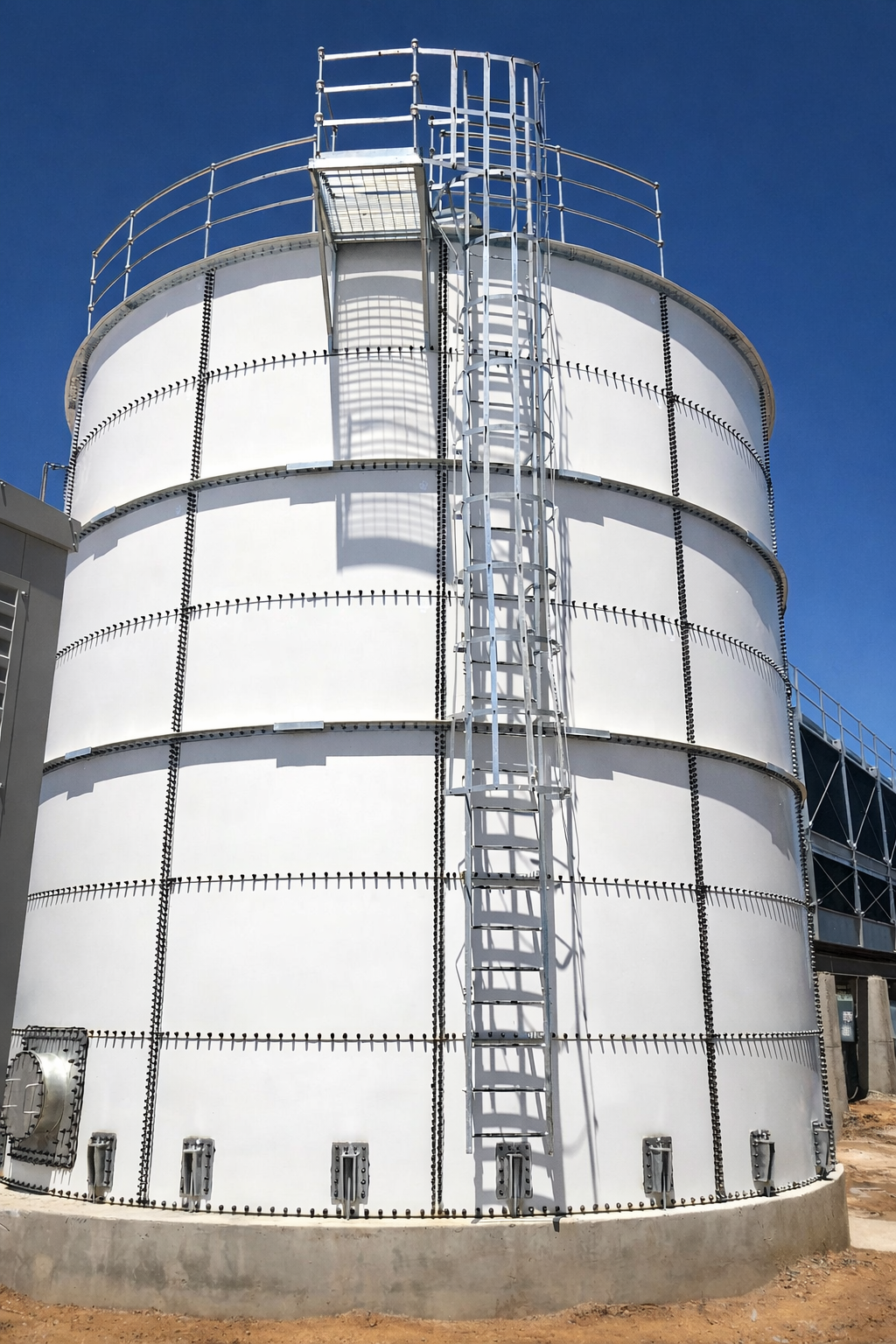
Epoxy coatings applied to bolted metal tanks provide a highly effective barrier solution for protecting steel against corrosion and chemical agents, especially in installations where the stored fluids or the external environment are more aggressive than in traditional non-potable water or fire protection applications. Unlike galvanizing, epoxy does not act sacrificially, but rather as a waterproof film with insulating properties, which is why its correct application and adhesion are crucial.
Epoxies can be applied by spraying, rolling, or using FBE (Fusion Bonded Epoxy) systems, achieving typical thicknesses between 250 and 500 microns, depending on the intended use. These thicknesses offer excellent resistance to moisture, moderate chlorides, wastewater, sludge, and mildly corrosive industrial fluids. The selection of the epoxy system should consider parameters such as fluid pH, maximum service temperature, presence of abrasives, and solids content, as these factors can directly affect its longevity.
Surface preparation is critical: typically, an Sa 2.5 grade is specified using abrasive blasting, as poor adhesion can lead to defects such as blistering, delamination, or film loss. Continuity tests—such as the holiday test with voltages between 1,250 and 1,500 V—verify the absence of pores or discontinuities. For tanks intended for potable water, there are certified epoxy formulations that meet safety standards, allowing their use in water intake, treatment, and sanitary storage.